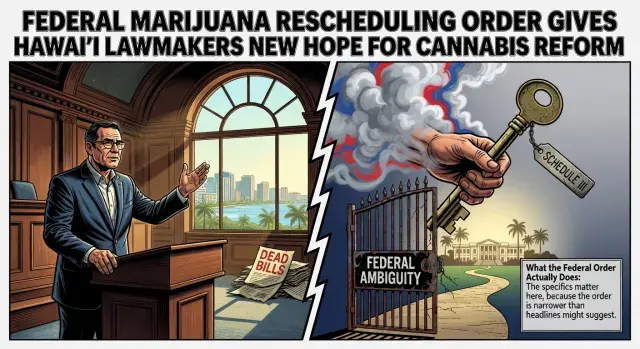
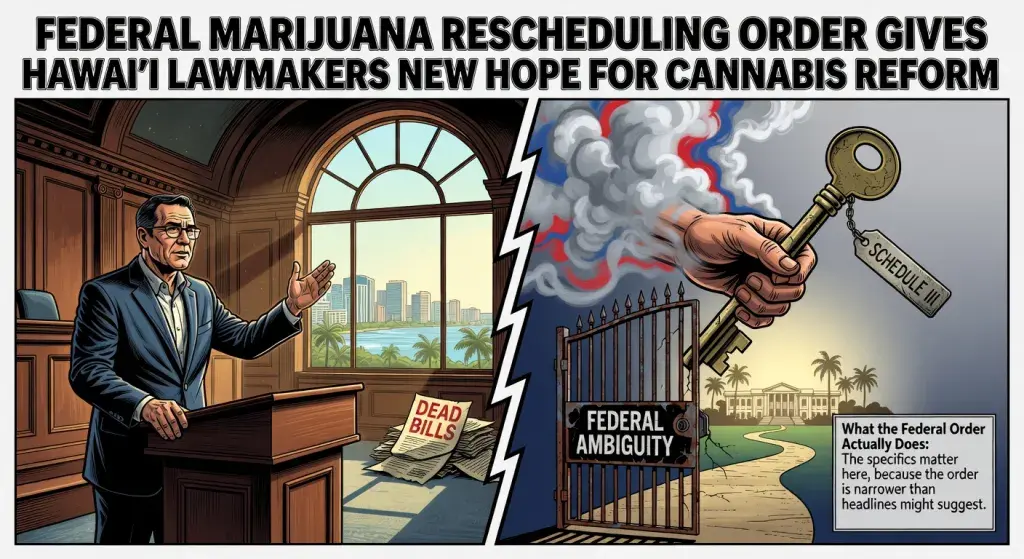
After years of watching his recreational cannabis bills die quiet deaths in the Hawai'i State Legislature, Big Island Representative David Tarnas has found an unlikely source of optimism: the Trump administration's Department of Justice. Acting Attorney General Todd Blanche's order to reclassify medical-grade marijuana from Schedule I to Schedule III marks the most consequential shift in federal cannabis policy in decades - and it's already reverberating through statehouses like Honolulu's, where legalization efforts have long stalled against a wall of federal ambiguity.
What the Federal Order Actually Does
The specifics matter here, because the order is narrower than headlines might suggest. Blanche's directive immediately places two categories of marijuana into Schedule III of the Controlled Substances Act: FDA-approved drug products containing marijuana, and medicinal marijuana products regulated under a qualifying state license. That's it. Recreational cannabis remains untouched - for now.
But the downstream effects could be substantial. Schedule I classification - the category marijuana has occupied alongside heroin, LSD, and ecstasy since the Nixon era - designates a substance as having no accepted medical use and high abuse potential. Schedule III, home to codeine, ketamine, and anabolic steroids, acknowledges moderate to low dependence risk. The practical difference is enormous: it opens the door to federally sanctioned research, eases banking restrictions for medical cannabis businesses, and eliminates certain tax penalties that have strangled state-legal operators for years.
An expedited administrative hearing beginning June 29 will consider the broader question of rescheduling all marijuana from Schedule I to Schedule III. Notice will be published in the Federal Register. The DOJ framed it as providing "a timely and legally compliant pathway to evaluate broader changes to marijuana's status under federal law."
Hawai'i's Long, Complicated History with Cannabis
Hawai'i holds a quiet distinction in cannabis policy. In 2000, it became the first state to legalize medical marijuana through its legislature rather than by ballot initiative. That was a quarter century ago. And yet recreational use remains illegal, with only a narrow decriminalization carve-out - possession of three grams or less - signed into law in 2019 by then-Governor David Ige, who notably let the bill become law without putting his name on it.
Tarnas, who represents North and South Kohala, has pushed recreational legalization bills session after session. None have gained traction. The reasons are familiar to anyone who follows state-level cannabis politics: lingering cultural conservatism, law enforcement opposition, and - critically - the persistent tension between state legalization and federal prohibition. That last factor has provided convenient cover for legislators reluctant to act.
"It's only the beginning and there are still a lot of questions," Tarnas told Big Island Now. "Folks in the community and the industry are uncertain how it will affect the current status quo."
Here's the catch: the federal rescheduling doesn't legalize anything at the state level. Hawai'i's medical cannabis program will continue operating under existing state law. The State Department of Health confirmed as much on Friday, stating there are "no immediate changes to state law or program operations." But Tarnas is watching for what comes next - particularly whether the federal government might eventually reschedule recreational cannabis too.
The Practical Gap Between Rescheduling and Legalization
It's worth being clear-eyed about what rescheduling does not accomplish. Moving marijuana to Schedule III is not legalization. It does not create a federal right to possess or sell cannabis. It does not resolve the patchwork of contradictory state laws. And it does not address the hundreds of thousands of people who have been convicted under existing drug statutes.
What it does is remove the most absurd contradiction in federal drug policy - the insistence that a substance used medically in 38 states has "no accepted medical use." That fiction has hampered clinical research for decades, forcing scientists to jump through bureaucratic hoops that don't apply to far more dangerous substances.
DEA Administrator Terry Cole emphasized that law enforcement priorities remain unchanged: "Our men and women in law enforcement remain committed to fighting drug cartels, the fentanyl epidemic, and protecting American lives." The message is calibrated - a nod toward reform without conceding the drug war framework.
For Hawai'i specifically, the Health Department said it is "actively coordinating with federal partners and state agencies to understand how this change will affect Hawaiʻi's medical cannabis program." Translation: nobody knows yet. And that uncertainty, more than anything, captures where American cannabis policy stands in mid-2025 - somewhere between prohibition and acceptance, with the federal government finally, grudgingly, inching toward coherence.
"I'm hopeful, and I'm monitoring it closely," Tarnas said. Given his track record, he's used to waiting.