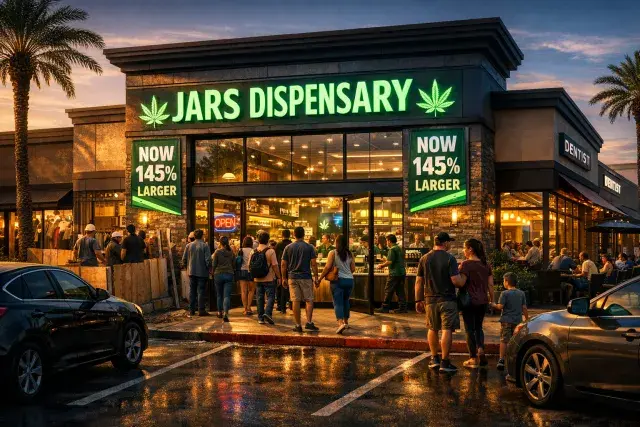
A small Michigan city on the Wisconsin border is running a live experiment in what happens when a cannabis market expands without a license cap. Menominee, Michigan - population under 9,000 - is approaching eight licensed adult-use dispensaries, drawing tax revenue and traffic congestion in roughly equal measure. For dispensary operators, city officials, and multi-state operators eyeing border markets, what's unfolding here is worth watching closely.
The Cap Is Gone. The Complications Aren't.
Menominee previously limited retail cannabis licenses to two. That cap didn't survive a legal challenge, and the city now finds itself without a hard ceiling on operator count. It's a situation that plays out in adult-use states more often than regulators anticipate: a municipality sets a license limit, that limit gets contested in court, and the city is left to manage growth through whatever secondary tools it has available - primarily zoning.
Zoning is a blunt instrument. It can restrict where a dispensary opens, how close it can be to schools or houses of worship, how traffic flows on and off the property. What it can't easily do is unwind licenses already issued. In Menominee, the tension is visible at a single intersection - 10th Avenue and 10th Street - where an eighth retail location is set to open in a former auto shop. City council members have raised concerns about alley routing for drive-thru traffic. Mayor Casey Hoffman has flagged proximity to a church, a Boys & Girls Club, and an elementary school walking path. These aren't abstract objections. In regulated cannabis retail, buffer zone violations - even ones that emerge post-issuance due to changed site conditions or errors in the original application - can generate license review proceedings, neighbor complaints, and nuisance designations that carry real legal weight.
Hoffman was direct: if traffic complaints accumulate, he intends to pursue a nuisance determination. That's a specific legal mechanism, not just political frustration, and operators moving into contested locations should take that framing seriously.
Border Markets and the Wisconsin Variable
Menominee sits directly across the Menominee River from Marinette, Wisconsin. Wisconsin has not legalized recreational or medical cannabis - CBD oil remains the extent of what's permitted. That single regulatory asymmetry is, effectively, a demand driver. Wisconsin residents crossing into Michigan represent a real and recurring customer base, which is part of why the Menominee market has attracted both local operators and, according to local accounts, multi-state operators looking to plant a flag in a high-traffic border location.
Border market dynamics are well-documented across adult-use states. Retail volume in towns adjacent to prohibition-state lines tends to outperform comparable markets inland. Operators understand this. So do investors. The problem is that the same foot traffic that makes a border location commercially attractive also strains local infrastructure - parking, road capacity, residential adjacency - that was never designed around high-volume retail.
Mayor Hoffman acknowledged the contingency explicitly: if Wisconsin legalizes or if Michigan adjusts its wholesale tax structure in ways that compress margins, some of that cross-border demand evaporates. The market could thin on its own. That's a reasonable long-term scenario - but operators who have signed leases, built out POS infrastructure, hired staff, and invested in seed-to-sale compliance systems are carrying fixed costs that don't shrink with demand.
What Saturation Actually Means for Operators
Nilsson Davis, the owner of Elevated Exotics and a Menominee County resident, offered a distinction worth unpacking. From his vantage, the local market is "flush and growing" - not saturated. That's a meaningful operational read. Saturation, in cannabis retail, doesn't announce itself cleanly. It shows up first in wholesale pricing pressure, then in average transaction values, then in customer acquisition costs as dispensaries within a few miles of each other compete for the same adult-use consumer base.
Davis also flagged something that resonates beyond Menominee: multi-state operators entering a local market don't always carry the same community accountability as a resident operator. That's not a sentimental observation - it has real operational implications. A locally owned shop has reputational skin in the game with city council, neighbors, and the school two blocks away. A regional or national MSO managing dozens of retail locations across multiple license states is optimizing at a different scale. Community relations, in a market this size, can determine whether a nuisance complaint becomes a footnote or a license threat.
Tax Revenue Is Real. So Are the Tradeoffs.
Menominee collected $400,000 in cannabis tax revenue in 2024 from its expanded roster of licensed shops. For a small municipality, that's material. It funds things. It also creates a quiet tension in the policy conversation: the same officials voicing concern about neighborhood safety and traffic congestion are receiving tax receipts that depend on the continued operation of the businesses generating the problem.
This is not unique to Menominee. Across adult-use states, municipalities that initially resisted retail cannabis - or capped it aggressively - have revised their posture once they saw the excise tax and local tax allocations flowing to other jurisdictions. The fiscal calculus shifts. That doesn't mean every location or every operator is appropriate, but it does mean the political will to actually shut down a compliant, licensed dispensary on nuisance grounds faces a higher bar than the rhetoric sometimes suggests.
For operators in Menominee and markets like it: the story here isn't simply that a small city has too many dispensaries. It's that when license caps fall and border demand is strong, retail density can outrun the regulatory and zoning framework meant to manage it - and the businesses that opened last are the ones most exposed when local officials start looking for leverage.