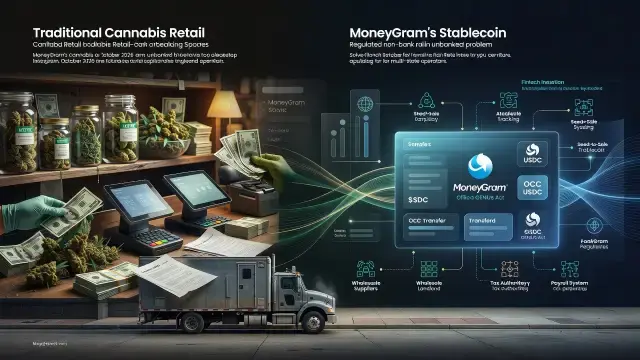
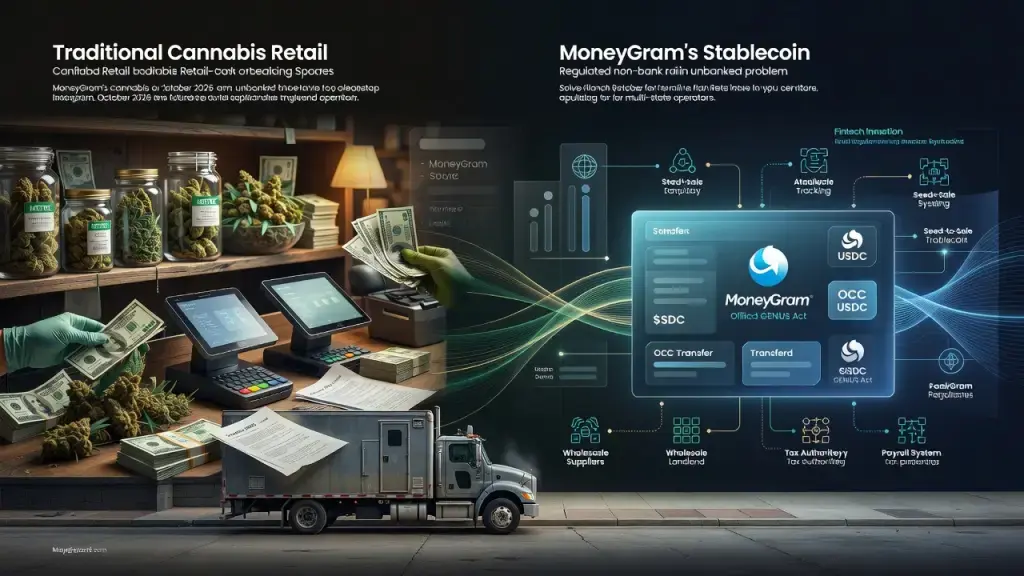
MoneyGram's October 2026 launch of a stablecoin-backed banking app has nothing to do with cannabis directly - the company has not announced any plans to serve plant-touching businesses, and nothing in its product rollout mentions the industry. But dispensary operators and multi-state operators tracking payment innovation should pay attention anyway, because the structural problem MoneyGram just addressed for unbanked remittance customers looks a lot like the problem cannabis retailers have lived with for a decade.
The Cash Problem Cannabis Already Knows
Federal illegality keeps most national banks and card networks away from plant-touching cannabis businesses, forcing dispensaries into cash-heavy operations, armored transport contracts, and workaround payment processors that charge premium fees. Point-of-sale systems built for cashless transactions exist, but many run on cashless ATM workarounds that sit in a legal gray zone the card networks have periodically cracked down on. The result: higher costs, inventory shrinkage risk from holding cash on-site, and compliance logs that have to reconcile physical currency against seed-to-sale tracking in METRC.
What MoneyGram demonstrated is a different model entirely - a licensed money transmitter holding dollar-denominated, stablecoin-backed balances for consumers without requiring a traditional bank account. That's not a cannabis solution. Federal law still treats cannabis revenue as proceeds touchable by anti-money-laundering statutes regardless of what settlement rail moves the money. But the architecture - a regulated non-bank issuing compliant, audited stablecoin balances under a framework like the OCC's GENIUS Act - is exactly the kind of infrastructure cannabis payment vendors have been asking federal regulators to bless for years.
Why the Banking Gap Still Matters for Operators
Dispensary owners don't need crypto exposure. What they need is predictable, low-cost, compliant money movement between wholesale suppliers, landlords, tax authorities, and payroll - the same unified treasury problem MoneyGram just solved for remittance customers. Right now, a typical multi-state operator might juggle a cannabis-friendly community bank account, a separate cash-management vendor, and manual reconciliation against POS terminals and wholesale invoices. Every one of those seams adds cost and compliance risk under Section 280E, which already denies standard business deductions to plant-touching companies and makes margin management brutal.
If regulated stablecoin infrastructure keeps maturing - and the OCC's final rule earlier in October suggests federal regulators are building real guardrails rather than leaving the space in a gray zone - it's reasonable to expect fintech vendors serving cannabis to study the MoneyGram model closely. Not to let consumers pay in crypto at the counter, but to build cleaner back-office rails for excise tax remittance, wholesale settlement, and vendor payouts.
What Compliance Teams Should Track
None of this changes anything for dispensary operators today. Age verification, compliant packaging, lab testing and COA requirements, and state seed-to-sale reporting remain unaffected by payment-rail innovation happening in the remittance sector. But compliance and finance teams at cannabis companies should treat this as an early signal worth logging, not acting on.
- Federal banking access for cannabis remains unresolved regardless of stablecoin innovation elsewhere
- Regulated stablecoin frameworks like the GENIUS Act could eventually inform cannabis-specific payment guidance, but no such extension currently exists
- Operators should continue relying on licensed, cannabis-compliant financial institutions and avoid unregulated crypto workarounds that create their own compliance exposure
- Any payment processor claiming crypto-based "banking" for cannabis businesses today warrants real scrutiny - the regulatory clarity MoneyGram relied on has not been extended to plant-touching commerce
The honest takeaway is narrower than it might sound: MoneyGram proved that regulated, non-bank stablecoin infrastructure can work at consumer scale. Cannabis retail still sits outside that regulatory perimeter. Operators should watch the trend, not assume it applies to them yet.