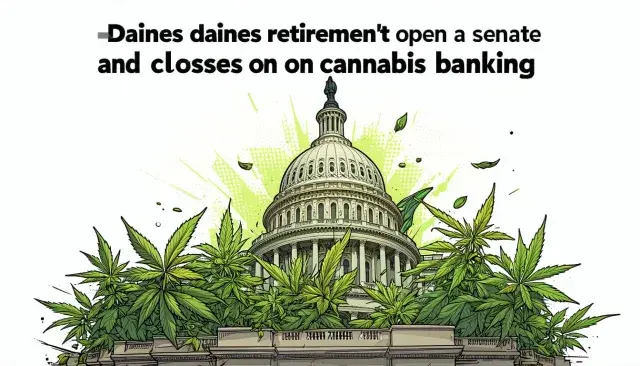
Steve Daines won't seek a third term in the U.S. Senate, and for Democrats eyeing the chamber's math in 2026, Montana just got interesting. But the announcement carries a quieter consequence for an issue that has spent years bouncing between legislative momentum and political obstruction: the push to give cannabis businesses lawful access to federally regulated banks may have just lost its most prominent Republican voice.
A Rare Bipartisan Sponsor Steps Away
Since taking his Senate seat in 2015, Daines positioned himself as something unusual - a Republican from a conservative state willing to publicly champion banking access for the cannabis industry, on practical grounds rather than ideological ones. His case was straightforward: state-licensed cannabis businesses, locked out of the traditional banking system by federal law, are forced into all-cash operations. That cash concentration draws theft, invites tax evasion, and makes the work of distinguishing legitimate operators from criminal enterprises harder for law enforcement, not easier.
The bill he anchored - the Secure and Fair Enforcement Regulation Banking Act, known as SAFER Banking - represented the furthest the measure had ever traveled in the Senate. In September 2023, the Senate Banking Committee approved it 14-9, the first time any version of the legislation had cleared a Senate committee. The thing is, clearing committee and reaching the floor are two very different things. Then-Majority Leader Chuck Schumer never brought it to a vote, and the moment passed.
It wasn't the first time the legislation stalled at the finish line. The House passed earlier versions of the SAFE Banking Act seven times between 2019 and 2022, only to watch each one expire in the Senate under Mitch McConnell's majority. Seven times. That pattern says something about the structural difficulty of moving cannabis-adjacent legislation even when the underlying policy rationale enjoys genuine bipartisan support.
What Losing Daines Actually Means for the Bill's Prospects
Republican co-sponsorship of cannabis banking legislation isn't purely symbolic - it signals to skeptical colleagues that the bill can be defended at home. Daines represented Montana, a state that has voted Republican in presidential elections for decades and has an adult-use cannabis marketplace operating under state law. That combination gave him a particular kind of credibility on the issue: he wasn't a coastal Democrat managing political optics. He was a conservative senator arguing that cash-only drug commerce is a public safety problem that banking reform could help solve.
Montana's other senator, Tim Sheehy - the Republican who unseated Democrat Jon Tester in 2024 - has not yet weighed in publicly on cannabis banking reform. Sheehy's position, if he takes one, will matter. But there's no established record to read forward from, which is itself a meaningful absence.
Meanwhile, Daines has endorsed Kurt Alme to succeed him - a federal prosecutor and Trump appointee who, when former Attorney General Jeff Sessions rescinded the Cole Memo in 2018, signaled that his office would apply standard federal prosecution principles to marijuana cases. That's not an extreme position, but it's a notably different posture than the one Daines held. Alme's statement at the time emphasized continued focus on safety threats rather than blanket enforcement, which leaves his ultimate stance on cannabis banking genuinely ambiguous. Still, endorsement by a departing champion for reform doesn't tell you much about whether the endorsed candidate will carry that cause forward.
The Broader Policy Vacuum
With Republicans controlling both chambers in the current Congress, no version of the SAFE or SAFER Banking Act has been introduced. That's not a coincidence. It reflects both the absence of a legislative sponsor willing to lead and the broader ambivalence within the Republican conference about any bill that touches cannabis - regardless of how modest the underlying policy is.
To be precise about what the legislation actually does: it doesn't legalize cannabis. It doesn't change the federal scheduling status of the drug. It does one thing - it provides legal safe harbor to banks, credit unions, and other federally regulated financial institutions that choose to serve businesses operating lawfully under state law. Twenty-three states have adult-use cannabis markets. Virginia is closing in on becoming the twenty-fourth. In each of those states, legal businesses are routinely denied checking accounts, credit, payroll processing, and insurance - not because they've broken any state law, but because their industry remains federally prohibited.
The downstream effects of that gap are real and documented. Cash-intensive businesses generate audit trails that are harder to follow, create physical security risks, and complicate tax collection. Law enforcement agencies in legal states have consistently flagged the problem. That's the ground Daines stood on, and it was reasonably solid ground.
Whether any Republican senator picks up that argument before the 2026 cycle remains to be seen. In practice, though, the departure of a senior sponsor in the majority party - for a bill that has already struggled through multiple Congresses - is rarely a good sign for the legislation's near-term prospects. The political opening Daines is leaving behind in Montana may benefit Democrats at the ballot box. The policy opening he's leaving behind may simply remain open, unfilled, for a while longer.