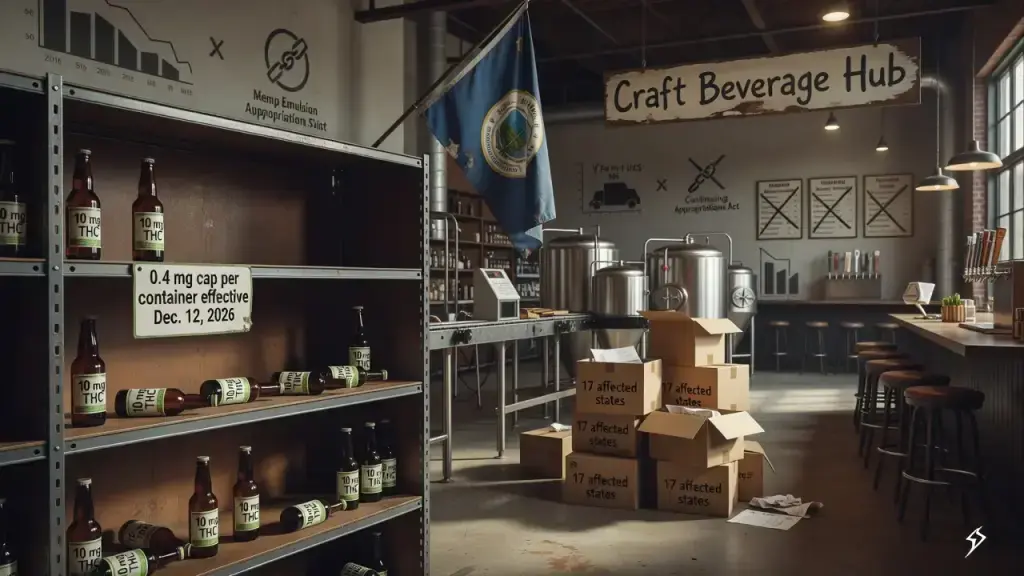
A federal law set to take effect Dec. 12, 2026 will strip hemp-derived THC beverages off liquor store shelves, out of taprooms, and off restaurant menus nationwide. In Minnesota, where regulators built one of the country's most developed frameworks for these products, the fallout is already arriving months ahead of the deadline - in sales forecasts, staffing decisions, and contracts with out-of-state distributors.
How a Farm Bill Loophole Built an Industry
The 2018 Farm Bill removed hemp from the federal controlled substances schedule, with lawmakers assuming the crop would go toward fiber, grain, and non-intoxicating CBD. That's not quite what happened. Beverage makers found a workaround: derive THC from hemp rather than marijuana, and suddenly you have an intoxicating product that doesn't fall under state cannabis licensing regimes. Regulation varied wildly by state. Minnesota, to its credit, didn't leave the market unregulated - a 2022 law set dosage caps, a 21-plus purchase age, and allowed sales through general retail channels including liquor stores and bars. That regulatory clarity turned Minnesota into something unusual: a co-packing hub where breweries with spare production capacity formulate and bottle hemp beverages for brands across the country, not just their own labels.
A Business Model Now Facing Contraction
The Continuing Appropriations Act, signed in November 2025 to end a record government shutdown, redefined hemp at the federal level and capped THC content at 0.4 milligrams per container - far below Minnesota's own 10-milligram beverage limit. Once the ban takes hold, interstate shipment of these products becomes illegal regardless of what individual states allow. For producers who built multi-state distribution networks, that's not a policy footnote. It's a structural problem. Losing legal access to 17 of 18 distribution states, as one producer described it, isn't a dip in revenue - it's a different business. Supply chains run both directions, too: hemp emulsion sourced from out-of-state suppliers would also become impossible to move across borders, choking production even for beverages sold only within Minnesota.
Layoffs Before the Deadline Even Arrives
Retailers have started trimming orders months in advance, wary of ending up with unsellable inventory and tax complications after the cutoff date. That caution moves backward through the supply chain fast - distributors buy less from producers, producers scale back formulation and co-packing work, and hiring freezes turn into attrition-driven headcount reductions. Sales representatives at distributors have already lost jobs. Brewery staff have been quietly reassigned rather than let go, for now. The ambiguity itself carries a cost: businesses can't plan production schedules, staffing levels, or new product launches against a deadline that keeps shifting by 30-day extensions.
What's at Stake for Retailers and State Revenue
Hemp-derived beverages have become a meaningful revenue line for liquor stores and bottle shops, with some independent retailers reporting that these products make up roughly a third of sales. Minnesota collected tens of millions in state tax revenue from lower-potency hemp products over a recent ten-month stretch - money that disappears from state coffers if the category vanishes. For breweries that leaned on THC beverages to offset declining beer volume after the pandemic reshaped drinking habits, the ban isn't a marginal product-line adjustment. It threatens the viability of operations that built real production capacity, hired real staff, and signed real distribution contracts around a product the federal government is about to outlaw.
- Federal THC cap: 0.4 mg per container versus Minnesota's 10 mg beverage limit
- Effective date: Dec. 12, 2026, absent further extension or legislative fix
- Interstate shipment of compliant hemp beverages becomes illegal regardless of state law
- Impact spans manufacturing, distribution, retail, and hospitality employment