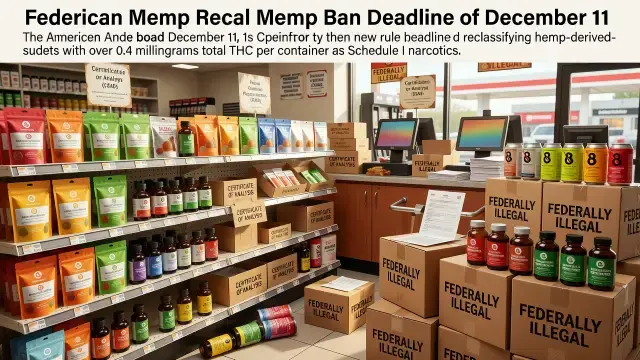
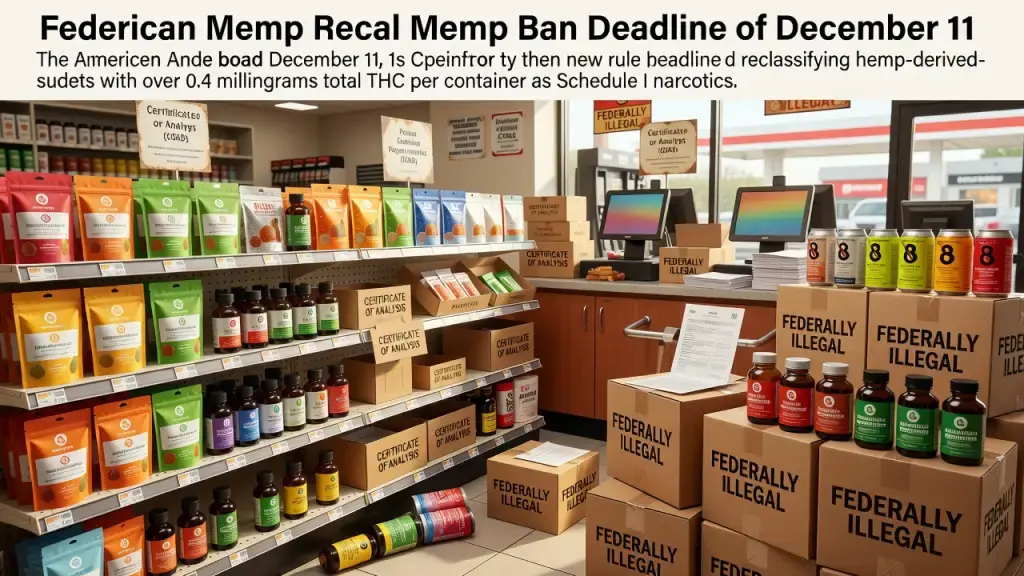
A federal deadline now set for December 11 will reclassify thousands of hemp-derived CBD and THC products as Schedule I narcotics, effectively wiping out a category that has filled convenience store shelves, wellness shops and online storefronts since 2018. The rule caps total THC per container at 0.4 milligrams - a threshold so low that it bans nearly every full-spectrum gummy, tincture or beverage on the market, regardless of how little intoxicating effect the product actually produces.
A regulatory gap finally comes due
The 2018 farm bill opened the door to legal hemp cultivation but never built the regulatory scaffolding to go with it. No federal testing standard. No uniform labeling requirement. No clear lane for the FDA to approve or deny these products. Into that vacuum rushed a market of synthetic and high-potency cannabinoids - delta-8, delta-10 - sold with little oversight through gas stations and smoke shops, often without age verification or consistent lab testing. That regulatory gap is precisely what lawmakers are now trying to close, albeit with a method critics call far too blunt. Banning the entire plant category to catch bad actors is, as more than one operator has put it, like shutting down a pharmacy because a few vending machines sold counterfeit pills.
What changes for retailers and brands
For dispensary operators licensed under state marijuana programs, little changes operationally - those products derive from marijuana, not hemp, and remain governed by existing seed-to-sale tracking, state excise tax and dispensary licensing rules. The disruption lands squarely on hemp-derived brands selling outside the dispensary channel: wellness retailers, grocery and convenience stores, direct-to-consumer beverage companies, and the wholesale networks that supply them.
- Any container with more than 0.4 mg total THC becomes federally illegal to sell, regardless of serving size claims on the label.
- Full-spectrum products - those retaining the plant's natural cannabinoid profile - are almost impossible to formulate under that limit, according to industry executives.
- Broad-spectrum products with little or no THC may survive, but companies will need updated certificates of analysis (COAs) to prove compliance.
- Synthetic cannabinoid products face an earlier cutoff, effective November 12.
That means SKU rationalization across the board: brands pulling products from wholesale menus, retailers rewriting shelf sets, and compliance teams scrambling to verify every batch against the new threshold before the deadline hits.
The compliance scramble ahead
Here's the catch for operators trying to plan around this: the deadline has already moved once, and a patchwork of state-level hemp programs means the ban won't land uniformly. States with their own regulatory frameworks may still permit licensed retailers to sell certain hemp products, creating a confusing map where legality depends entirely on zip code. Payment processors, point-of-sale vendors and e-commerce platforms serving hemp brands will need to update product categorization logic fast, since selling a now-federally-illegal item through a standard merchant account carries real liability.
Bipartisan legislation from Sens. Rand Paul and Amy Klobuchar would let states opt out of the ban entirely, and similar bills are circulating in the House. Another short-term extension isn't out of the question - Congress has already granted one. But operators building inventory plans, wholesale contracts and tax projections around a moving deadline are, fair enough, in a tough spot. For an industry already managing 280E tax exposure and inconsistent banking access, a compressed compliance window adds real operational risk on top of regulatory uncertainty.
Consumer-safety stakes remain real
None of this erases the underlying safety concerns that helped build momentum for the ban in the first place: unregulated synthetic cannabinoids, inconsistent lab testing, and products reaching minors without proper packaging or age verification. Poison control centers have fielded calls tied to children ingesting cannabis edibles, and cannabis use carries documented risks around cognitive impairment, sleep disruption and, for frequent users, cannabis use disorder. Whatever Congress ultimately decides, the compliance infrastructure the industry builds next - standardized testing, consistent labeling, verified THC thresholds - will matter more than the deadline itself.