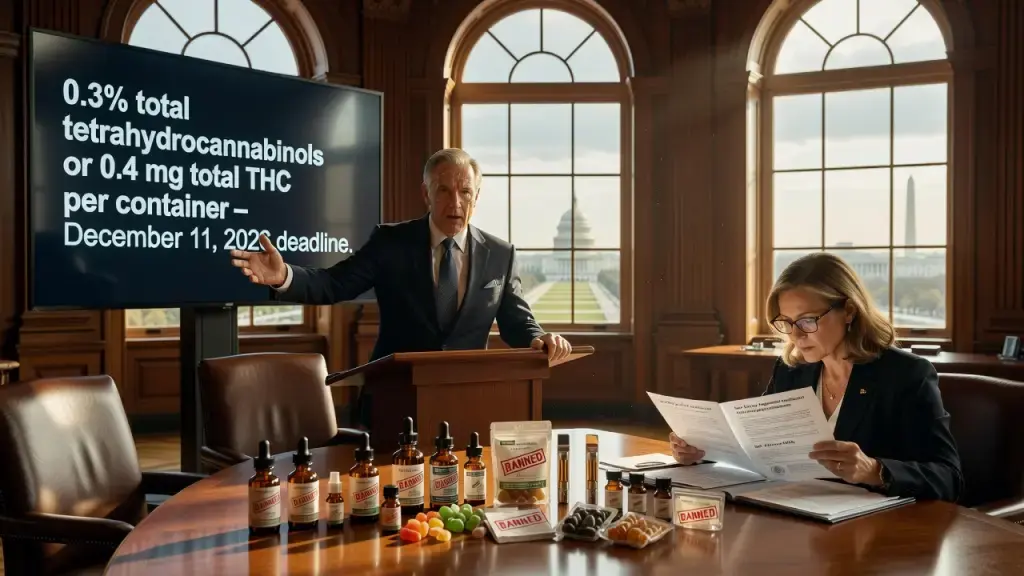
A new federal THC threshold for hemp products is barreling toward implementation, and the industry is still waiting to find out which version of the rule actually survives. The Continuing Appropriations, Agriculture, Legislative Branch, Military Construction and Veterans Affairs, and Extensions Act, 2026 set a cap of 0.3% total tetrahydrocannabinols or 0.4 mg total THC per container, originally slated for November 12, 2026. A short-term funding bill passed by the House in September pushed that date to December 11, 2026 - a reprieve, not a resolution.
What the Cap Would Actually Do
Jonathan Miller, general counsel for the US Hemp Roundtable, puts the stakes bluntly: a 0.4 mg limit "would ban 95% of products currently on the market." That is not a narrow correction aimed at intoxicating edibles or vape cartridges. It is a threshold low enough to sweep in full-spectrum CBD oils, tinctures, and other products that were never designed to intoxicate anyone. The 2018 Farm Bill opened the door to legal hemp by distinguishing it from marijuana on a dry-weight THC basis, but that same framework left room for high-potency hemp-derived products to proliferate. Subsequent legislation has tried to close that gap - the problem is the closing mechanism may be too blunt an instrument.
Alleh Lindquist, director and CEO of FloraWorks, raises a more technical concern. Broadly written statutory language, he warns, "could call into question standard hemp-processing methods such as extraction, purification, THC remediation, distillation, and decarboxylation." Those are not fringe techniques. They are the backbone of how compliant CBD and other non-intoxicating cannabinoid products get made in the first place. Regulate the endpoint too aggressively, and you risk criminalizing the process.
Signals From Washington Point in Different Directions
The White House has sent its own, somewhat contradictory, signal. Executive Order 14370, signed in December 2025, calls for an updated statutory definition of hemp-derived cannabinoid products that preserves access to full-spectrum CBD while still restricting products that pose health risks. In June 2026, the administration separately asked for revisions aligning federal hemp regulation with language from Amendment #54 to H.R. 8646, or at minimum an extension of the implementation timeline under Section 781. Representatives Andy Barr and Angie Craig introduced the Lawful Hemp Protection Act in late July, aiming to build a durable federal framework rather than another stopgap.
Lindquist's read on the moment is pragmatic: distinguish intoxicating THC products from naturally occurring, non-intoxicating cannabinoids, and "follow the known intent of the rules until we get more clarity." That is not a legal strategy so much as a survival posture - and it is the one most operators seem to be adopting by default.
Operational Reality Behind the Policy Fight
For companies manufacturing purified cannabinoid ingredients rather than finished consumer products, the 0.4 mg cap may be close to immaterial. FloraWorks' TruCBN, a purified cannabinol product, falls into that category - but Lindquist is clear-eyed that the broader hemp industry, including full-spectrum ingredients and higher-THC products intended for intoxication, will feel real impact. The company is pursuing a New Dietary Ingredient Notification with the FDA, with GLP toxicology work recently peer reviewed and a Self-Affirmed GRAS determination now in independent expert panel review - groundwork aimed at building the kind of safety data regulators increasingly expect.
State-level compliance remains its own grind, separate from the federal cap fight. Age restrictions and milligram limits mostly shape finished-product formulation, but the heavier lift is procedural: inconsistent testing requirements, documentation standards, licensing structures, and quality benchmarks across states. "In some states, we must hold specific licenses, maintain a local presence, or work through in-state partners," Lindquist notes - a patchwork that functions like a compliance tax on multi-state operations, regardless of what Congress eventually decides about THC limits.
What Operators Should Do Between Now and December
- Review product portfolios against the 0.3% total THC and 0.4 mg per-container thresholds before the current December 11 deadline
- Track state-by-state restrictions separately from federal action - Ohio and Illinois have recently joined roughly a dozen states with severe hemp product limitations
- Maintain current COA and testing documentation rather than making premature formulation changes
- Monitor whether Congress attaches a hemp fix to further appropriations action before the new deadline
Miller describes the Hemp Roundtable's goal as a framework that bans sales to minors, enforces good manufacturing practices, blocks synthetic imports, requires truthful labeling, and sets reasonable milligram limits - while leaving some of that detail to individual states rather than a single rigid federal number. He says the group is "cautiously optimistic" a fix arrives before the new deadline, given the administration's posture, but adds the group "will not give up the fight" regardless of outcome. Lindquist's advice to brands in the meantime is less about optimism than discipline: stay informed, hold steady, and avoid reshaping a business around a rule that has already moved once and could move again.