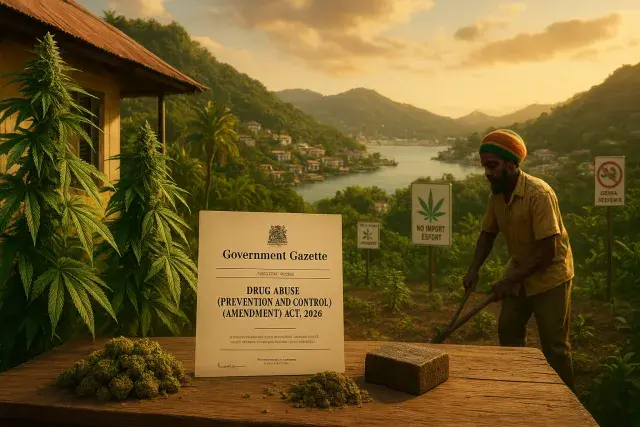
Grenada made cannabis policy history in February 2026, enacting the Drug Abuse (Prevention and Control) (Amendment) Act, 2026 - assented to on February 13 and published in the Government Gazette on February 20 - and establishing the most permissive personal possession limit in the Eastern Caribbean. Adults may now hold up to 56 grams of cannabis flower or 15 grams of cannabis resin without criminal exposure. No recreational retail framework exists yet, but the legislation signals a clear policy direction and sets a threshold nearly four times what Antigua and Barbuda allows under its 2018 decriminalization law.
For anyone tracking regulated cannabis markets regionally or globally, Grenada's move is worth understanding in structural terms. The Act is decriminalization, not legalization. Commercial recreational sales remain prohibited; the licensed framework is restricted to medical, therapeutic, scientific, and religious purposes. That distinction matters enormously for operators and investors watching the Caribbean for emerging retail opportunities. A functioning adult-use retail market - the kind that requires licensing infrastructure, seed-to-sale compliance, point-of-sale systems, lab testing mandates, and excise tax frameworks - does not yet exist on the island. Operators accustomed to building out compliant dispensary environments, say those familiar with how a cannabis dispensary pos system new york integrates inventory tracking, age verification, and tax reporting into a single workflow, will find no equivalent retail infrastructure ready to deploy in Grenada today. The regulatory architecture simply has not been built.
What the Act does build is a meaningful social and cultural framework. Home cultivation of up to four cannabis plants per premises is treated as medicinal, therapeutic, or horticultural in nature, with separate households on the same premises counted independently. The legislation also includes an expungement pathway for qualifying minor prior cannabis convictions - a provision that reflects genuine social-reform intent rather than a narrow policy adjustment. Most notably, the Act extends explicit protections to Rastafari sacramental use: the Minister may authorize Rastafari adherents, groups, or organizations to cultivate cannabis on designated lands under prescribed regulations, and registered Rastafari places of worship and designated exempt events receive specific legal protections. Legal observers following Caribbean cannabis reform have noted this represents one of the most direct statutory recognitions of Rastafari religious cannabis use in the region.
Public Consumption Rules Carry Real Penalties
Decriminalization does not mean unrestricted use. The Act expressly restricts public consumption. Use in or near public places can trigger a $300 fixed penalty or a $5,000 fine - and that is the less severe end of the scale. Cannabis use on school premises or within 100 yards of school premises during school hours carries significantly harsher penalties, including potential imprisonment. That enforcement architecture matters for any operator or hospitality business considering cannabis-adjacent programming for visitors. There is no formal social consumption licensing framework in place. The comfortable legal space for consumption is private.
Import and export restrictions remain intact for recreational purposes. The Act creates limited licensed exceptions for medical, therapeutic, and scientific contexts, but visiting tourists cannot assume personal cannabis products will clear customs. Bringing recreational cannabis into Grenada through any port of entry - airport or cruise terminal - remains illegal and carries the risk of denial of entry or repatriation. That is a compliance and liability reality any travel or hospitality operator advising clients on cannabis-friendly Caribbean destinations needs to communicate clearly.
Where Grenada Fits in the Broader Caribbean Cannabis Picture
The Caribbean cannabis regulatory map has shifted considerably in a short period. Jamaica operates licensed cannabis farm tours and retail dispensaries. Antigua and Barbuda runs dispensaries with consumption lounges open to tourists. Now Grenada has enacted a possession limit that exceeds both in generosity, without yet building the retail infrastructure to match. That gap - between policy ambition and market readiness - is the defining characteristic of Grenada's cannabis moment in 2026.
Here's the practical reality: the island's cannabis scene is informal, socially rooted, and connected to the Rastafari community that has shaped Grenadian culture since long before the current legislative cycle. That community depth gives Grenada a different character from purely transactional cannabis tourism destinations. It also means there are no licensed dispensaries, no regulated wholesale supply chains, no COAs attached to product batches, and no compliant packaging requirements governing what circulates informally. For operators, that is a market-formation observation, not a criticism. It simply describes where Grenada sits on the regulatory development curve.
For investors and operators watching the Caribbean for adult-use retail licensing opportunities, Grenada's trajectory is worth monitoring. The 56-gram possession threshold, the Rastafari cultivation authorization, and the expungement provisions collectively suggest a government with genuine reform intent rather than one enacting symbolic minimum compliance with regional pressure. When the commercial licensing framework eventually arrives - and the policy logic of this Act points in that direction - operators who understand Grenada's cultural and regulatory history will be better positioned to engage it seriously.
What the Act Does Not Yet Provide
To be direct about what is missing: no retail licensing regime, no testing or labeling standards for commercial product, no excise tax structure, no social consumption venue framework, and no formal tourist-facing cannabis access point. The infrastructure that makes adult-use markets function - compliance software, licensed cultivators, distribution manifests, potency testing requirements, packaging rules - has not been legislated into existence. Grenada enacted a strong decriminalization framework. It has not yet enacted a retail cannabis market.
That distinction is not a criticism of the Act. It is a description of where the island is in the regulatory cycle. Decriminalization frequently precedes commercial legalization by years. The gap between Antigua and Barbuda's 2018 decriminalization and its subsequent dispensary licensing demonstrates that trajectory clearly. Grenada in 2026 occupies the same early position. The policy foundation is laid. The commercial architecture remains to be built.