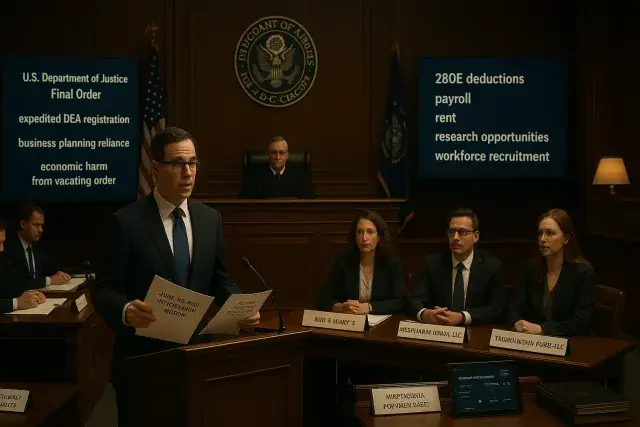
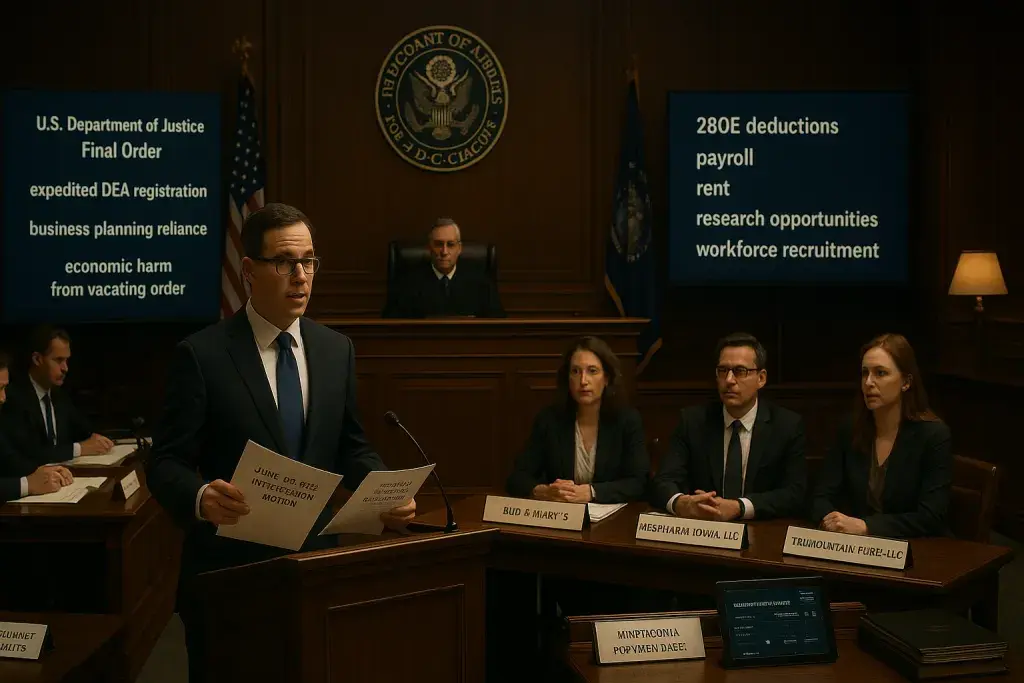
Two state-licensed medical marijuana operators filed a motion on June 29, 2026, seeking to intervene as party respondents in the consolidated rescheduling litigation pending before the U.S. Court of Appeals for the D.C. Circuit - putting themselves squarely on the side of the U.S. Department of Justice in defense of DOJ's April 28, 2026 Final Order on marijuana scheduling. The move carries real weight for licensed cannabis businesses across the country, many of which have been tracking the case with the kind of attention usually reserved for tax audits and license renewals. And now, a separate disclosure from MMJ International Holdings has added a potential conflict-of-interest wrinkle that the court may be asked to consider.
MedPharm Iowa, LLC, doing business as Bud & Mary's, and Tri-Mountain Pure, LLC are the proposed intervenors. Their filing is straightforward enough in its logic: they have already submitted applications for DEA registrations under the Final Order's expedited registration process for state-licensed medical marijuana operators, and they argue that vacating or staying the Final Order would cause them significant economic harm. The interests they cite read like a compliance officer's checklist - relief from Internal Revenue Code Section 280E, business planning undertaken in reliance on the Final Order, pending DEA registration applications, research opportunities, commercial relationships, and workforce recruitment. For operators who have spent years restructuring their books to minimize 280E exposure (the federal tax provision that bars cannabis businesses from deducting ordinary business expenses), the prospect of rescheduling delivering permanent relief is not abstract. It's a matter of survival-level cash flow. State-licensed operators across markets have been adapting their operations to anticipate this shift; in Missouri, for instance, dispensaries relying on their platform to manage point-of-sale compliance and inventory have had a direct operational stake in how federal classification affects day-to-day retail and reporting obligations.
The intervention motion was filed by attorney Shane Pennington of Blank Rome LLP. That's where things get more complicated. MMJ International Holdings - which is itself a party in the rescheduling litigation through its subsidiaries MMJ BioPharma Cultivation, Inc. and MMJ BioPharma Labs, Inc. - disclosed that it is reviewing communications exchanged with Pennington and Blank Rome during January 2026. According to MMJ, those communications included a formal conflicts review conducted by the firm and the circulation of a draft engagement letter following disclosures MMJ made regarding its federal regulatory activities. The company says it is evaluating whether those issues should be presented to the court. MMJ hasn't filed anything yet, but the fact that a potential prior engagement was discussed - complete with a conflicts check and a draft letter - is not something courts treat lightly.
What Section 280E Actually Means for Licensed Operators
It's worth being precise here. Section 280E of the Internal Revenue Code disallows deductions for businesses trafficking in Schedule I or II controlled substances. Because marijuana remains a Schedule I substance under federal law absent a final rescheduling, cannabis operators - even those fully licensed under state law - cannot deduct standard business expenses: rent, payroll, marketing, utilities. The effective tax rate for a compliant dispensary operating under 280E can be dramatically higher than for a comparable non-cannabis retailer. Rescheduling marijuana to Schedule III, which is what DOJ's Final Order does, would remove cannabis from the 280E restriction and allow licensed operators to claim ordinary business deductions for the first time. For multi-location operators and vertically integrated companies, that's not a marginal adjustment. It can reshape profitability across the entire enterprise.
That's precisely why the proposed intervenors' argument has weight. They're not claiming abstract regulatory benefit - they're pointing to concrete financial exposure if the Final Order is reversed. DEA registration applications already submitted, business plans already adjusted, commercial agreements already structured around the assumption that Schedule III status would hold. Courts evaluating intervention motions generally look at whether a party has a direct, substantial, and legally protectable interest in the proceeding. The economic case here is not difficult to make.
The Conflict Question and What It Could Mean for the Litigation
The ethics dimension is the part MMJ has been careful not to overstate - but also not to ignore. Professional responsibility rules governing attorneys are strict about conflicts of interest, and when a law firm conducts a formal conflicts review and circulates a draft engagement letter with a prospective client, that process typically creates obligations. Whether those obligations rise to the level of a disqualifying conflict - or something the court should be informed of - depends on the specifics of what was disclosed and what duties attached.
MMJ's framing is measured: the company says it is "evaluating" whether to present the issue to the court, not that it has concluded misconduct occurred. That's a responsible posture given that these questions are genuinely fact-specific. But the disclosure itself sends a signal to other parties in the consolidated litigation that MMJ is watching the procedural record closely. In complex federal regulatory cases, that kind of attention to the record is standard practice - and, in this context, particularly pointed.
The Broader Stakes for Cannabis Business and Federal Regulatory Policy
The consolidated rescheduling litigation before the D.C. Circuit is, by any measure, among the most consequential federal cannabis proceedings in decades. The Final Order represents the first time the executive branch has moved to reclassify marijuana through the formal administrative process. Challengers to the order - and their legal theories - vary, but the common thread is a dispute over whether DOJ followed proper administrative procedure and whether the scientific and legal findings supporting Schedule III placement are sound.
What the intervention motion makes visible is the business community's direct stake in the outcome. Licensed operators are no longer watching from the sidelines of federal cannabis policy. They are in court, arguing that their DEA registration applications, their workforce strategy, and their tax position depend on the Final Order surviving judicial review. That's a meaningful shift in how the regulated cannabis industry engages with federal administrative law.
For dispensary operators, compliance officers, and cannabis investors monitoring the case, the practical read is this: the litigation is contested, the parties are multiplying, and the procedural record now includes at least one significant disclosure that could affect how the court manages counsel going forward. The outcome is far from settled. And until it is, operators would be wise to maintain compliance planning for multiple regulatory scenarios - rescheduling complete, rescheduling stayed, or rescheduling vacated - rather than restructuring entirely around a result that remains in active dispute.