A unanimous U.S. Supreme Court ruling handed down Thursday holds that the federal government cannot categorically ban gun ownership by medical or recreational marijuana users who are not independently deemed dangerous - a decision with real operational implications for licensed cannabis businesses, state regulators, and the more than 100,000 active medical marijuana cardholders in Arkansas alone. For years, the intersection of federal firearms law and state-legal cannabis use has created a quiet but serious compliance burden that has kept many prospective patients away from dispensary counters entirely. That chilling effect, it turns out, has been measurable - and costly.
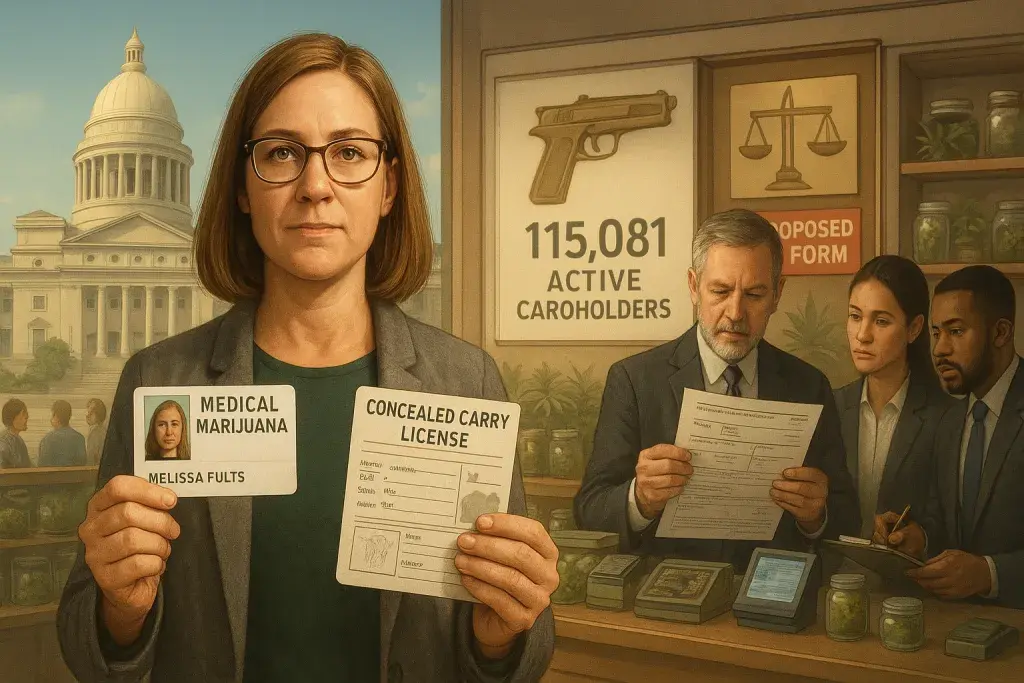
Melissa Fults, a 15-year cannabis advocate and medical marijuana cardholder from Hensley, Arkansas, put it plainly: people she knows personally chose to buy cannabis on the black market rather than register for a medical card and forfeit their gun rights. She estimates at least 50 such individuals in her immediate circle alone. That is not a small compliance footnote - it is a direct pipeline away from licensed retail and toward unregulated supply chains. Operators who track patient acquisition costs and dispensary foot traffic understand what that means for the regulated market. Compliance-conscious retail technology providers, including those building tools for states with newer adult-use frameworks - from cannabis point of sale vermont infrastructure to seed-to-sale integration - have long flagged patient hesitancy as a structural drag on cardholder enrollment numbers in medical-only states.
Arkansas legalized medical marijuana in 2016 via a voter-approved constitutional amendment, passing with 53% of the vote. As of early June, the Arkansas Department of Health reported 115,081 active medical marijuana cardholders. That figure represents the registered universe - the patients dispensaries can legally serve. If a meaningful share of eligible patients have been self-selecting out of the regulated system specifically over gun rights concerns, the ruling's downstream effect on dispensary patient volumes could be real, even if gradual.
The Compliance Gap the Ruling Does Not Fully Close
Here's the catch: the ruling, while unanimous, is also narrow. Bill Paschall, managing director of the Arkansas Cannabis Industry Association, described it in those exact terms - narrow, and somewhat ambiguous. The court's decision does not automatically rewrite federal administrative forms or ATF policy. The ATF's Firearms Transaction Record still contains language stating that marijuana use, whether medical or recreational, state-licensed or otherwise, disqualifies a buyer from purchasing a firearm under federal law. That form sits at the point of sale for every gun transaction in the country. Until it changes, the practical pathway for a cardholder to purchase a firearm remains murky at best.
A proposed revision to that ATF form is currently under federal review. According to reporting by MarijuanaMoment.net, the revision would remove any reference to state-authorized medical cannabis from the disqualifying language. If adopted, that change would represent the clearest administrative signal yet that federal enforcement posture toward medical marijuana patients and firearms is shifting. Paschall acknowledged this potential but stopped well short of declaring the issue resolved. That restraint is appropriate - proposed rule revisions move on their own timeline, and the distance between a court ruling and a revised federal form can stretch considerably in practice.
What Dispensary Operators and Patient Advocates Should Watch
For licensed dispensary operators in Arkansas and across the 41 states where medical marijuana is legal, the ruling creates a moment worth watching - not celebrating prematurely. The immediate business question is whether patient enrollment accelerates. If prospective cardholders who previously avoided the medical marijuana program over firearms concerns now feel safer registering, dispensaries could see incremental growth in their active patient base. That matters for wholesale purchasing decisions, inventory planning, and staffing at the budroom level.
What's striking here is how a federal court decision about constitutional rights intersects directly with dispensary sales economics. Compliance staff at multi-state operators and single-location medical dispensaries alike will want to monitor ATF form revisions closely. If the proposed changes to the Firearms Transaction Record are finalized, patient-facing communications - the kind that compliance and marketing teams draft together - may need updating to reflect the new landscape accurately. Fults herself said she hopes to reclaim her concealed carry license, which she surrendered when she obtained her medical marijuana card. She is almost certainly not alone in that position.
The Broader Signal for State-Legal Cannabis Markets
Arkansas Attorney General Tim Griffin and U.S. Rep. Rick Crawford both issued statements supporting the ruling on Second Amendment grounds - neither explicitly addressed cannabis policy. The Arkansas ACLU's executive director called it a sensible decision that protects millions of people's rights. The political coalition that forms around a ruling like this one is unusual in cannabis policy terms: gun rights advocates, civil liberties organizations, and medical marijuana patient groups arriving at the same conclusion from different directions. That alignment rarely lasts, but it does suggest the ruling carries broader public legitimacy than most cannabis-adjacent legal decisions manage to generate.
For the regulated industry, the long-term implication is straightforward. Any barrier that has pushed patients toward unregistered, untested, black-market cannabis - whether it was a tax burden, a proximity issue, a stigma concern, or a fear of losing gun rights - represents revenue that licensed operators never captured and compliance infrastructure that never got used. The Supreme Court did not resolve every tension between state cannabis law and federal prohibition. 280E still applies. Banking access remains constrained. But it removed one specific barrier that was, by any honest accounting, driving real people away from licensed dispensaries and into unregulated supply chains. That is a concrete change. The industry should treat it as one - carefully, with both eyes on what the ATF does next.