
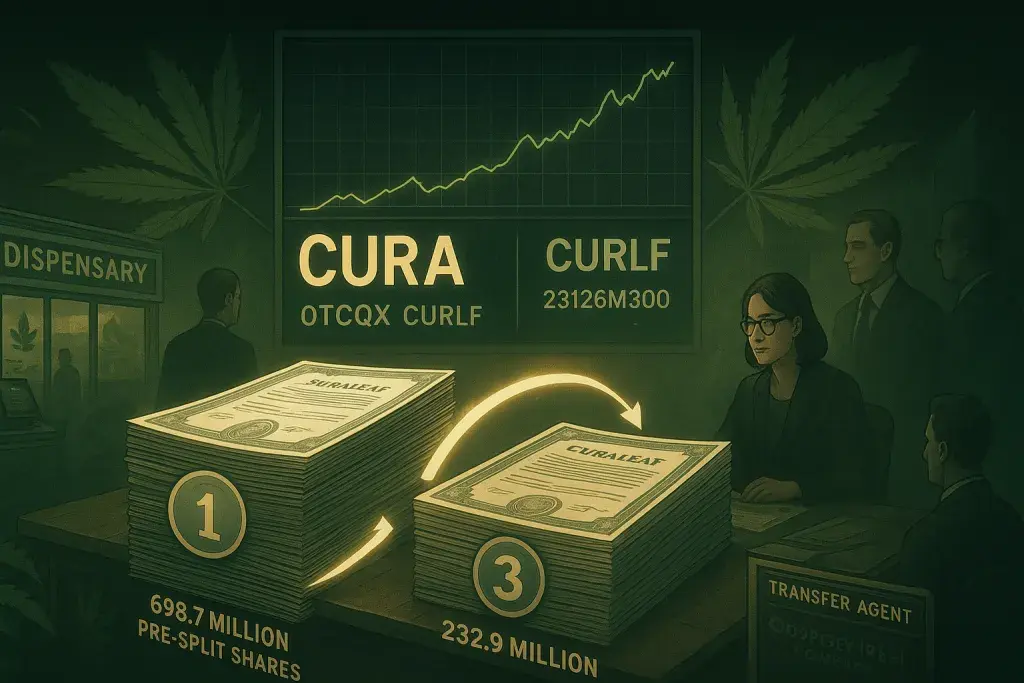
Curaleaf Holdings is consolidating its share structure. The multi-state operator confirmed this week that its previously announced 1-for-3 reverse stock split of subordinate voting shares takes effect June 5, 2026, reducing the company's outstanding subordinate voting share count from roughly 698.7 million to approximately 232.9 million. The move trades on the Toronto Stock Exchange under symbol CURA, now carrying a new CUSIP number - 23126M300 - while the OTCQX listing under CURLF remains in place.
For cannabis investors and operators tracking multi-state operator capital structures, a reverse stock split of this magnitude is worth understanding in operational context. Curaleaf is one of the largest vertically integrated cannabis companies by retail footprint in North America, with dispensary locations across several adult-use and medical markets. Institutional and retail investors who hold shares through brokers won't need to file any paperwork - their positions adjust automatically through their intermediaries. Registered shareholders, however, must return pre-split certificates along with a completed Letter of Transmittal to Odyssey Trust Company, the company's transfer agent. The mechanics here matter: missing that step doesn't eliminate the shareholder's position, but it does delay the issuance of updated certificates or direct registration advices. Operators and investors in regulated cannabis markets - from multi-state license holders to ancillary service providers tracking, say, pos cannabis new york deployments and the capital profiles of their retail partners - should note that Curaleaf's share consolidation runs concurrent with a matching 1-for-3 consolidation of its multiple voting shares, preserving the relative voting rights between share classes.
The company is not issuing fractional shares. Where the split would leave a shareholder holding a fraction, that number rounds to the nearest whole share - up or down. That's standard practice for consolidations of this type, and it limits administrative complexity for the transfer agent while keeping the math clean for registered holders with smaller positions.
What a Reverse Stock Split Actually Signals
To put it plainly: a reverse stock split doesn't change a company's market capitalization on its own. Three shares become one share, and in theory the per-share price triples - but the underlying value of a shareholder's total position stays the same. What it does change is optics and, in some cases, eligibility. Many institutional investors operate under mandates that restrict holdings in stocks trading below a certain price threshold. A higher nominal share price can reopen that window. For cannabis companies listed on exchanges with minimum price requirements, consolidating the float is sometimes a precondition for maintaining continued listing compliance.
Curaleaf hasn't cited a specific compliance trigger in this announcement, but the context is hard to ignore. Cannabis equities have faced persistent valuation pressure across publicly traded multi-state operators as federal rescheduling timelines have stretched and the cost of capital has remained elevated. A share count north of 698 million - common in cannabis companies that have grown through acquisition and equity issuance - can weigh on per-share metrics used by equity analysts and potential institutional buyers. Bringing that count down to roughly 232.9 million is a structural adjustment, not an operational one, but it shapes how the company appears on a brokerage screen.
Implications for Dispensary-Adjacent Stakeholders
For dispensary operators, vendors, and B2B partners evaluating Curaleaf as a wholesale buyer, retail partner, or capital-markets reference point, a reverse stock split is largely a financial housekeeping event. It doesn't alter the company's license holdings, its retail lease obligations, its supply chain relationships, or its compliance standing with state regulators. Operational metrics - same-store sales, wholesale revenue, gross margin before and after excise tax, inventory turns - remain the substantive indicators of business health.
That said, share structure matters when cannabis companies use equity to compensate management, acquire smaller operators, or raise fresh capital. A lower share count with a higher nominal price can make equity-based deal terms cleaner and can reduce dilution optics in future raises. For vendors and technology providers working with large MSOs on multi-year contracts, the financial stability signaled by capital-markets decisions like this one is relevant context - even if it doesn't show up directly in a purchase order or a compliance audit log.
What Shareholders Should Do Now
The practical checklist is short but time-sensitive.
- Beneficial shareholders holding through brokers or intermediaries: no action required - positions adjust automatically.
- Registered shareholders holding physical certificates or direct registration advices: complete the Letter of Transmittal mailed by Odyssey Trust Company and return it along with pre-split share certificates according to the instructions provided.
- Shareholders with questions about fractional share rounding or certificate processing should contact Odyssey directly.
- The new CUSIP number for post-split subordinate voting shares is 23126M300 - relevant for settlement systems and portfolio recordkeeping.
The split is effective June 5, 2026. After that date, any trading in CURA on the TSX reflects the consolidated share count. The OTCQX listing under CURLF adjusts in parallel. Curaleaf has published a Reverse Stock Split FAQ for additional guidance through its investor relations site.