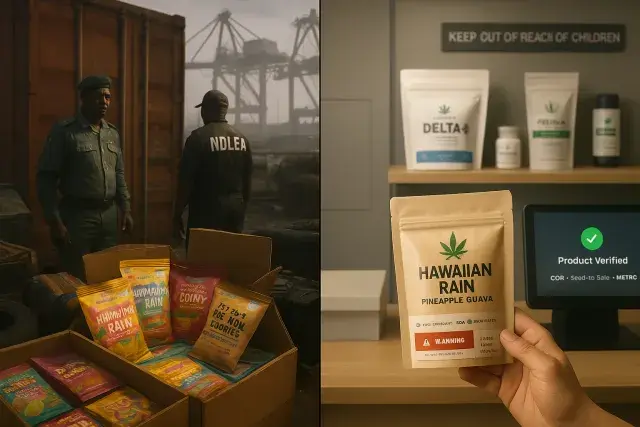
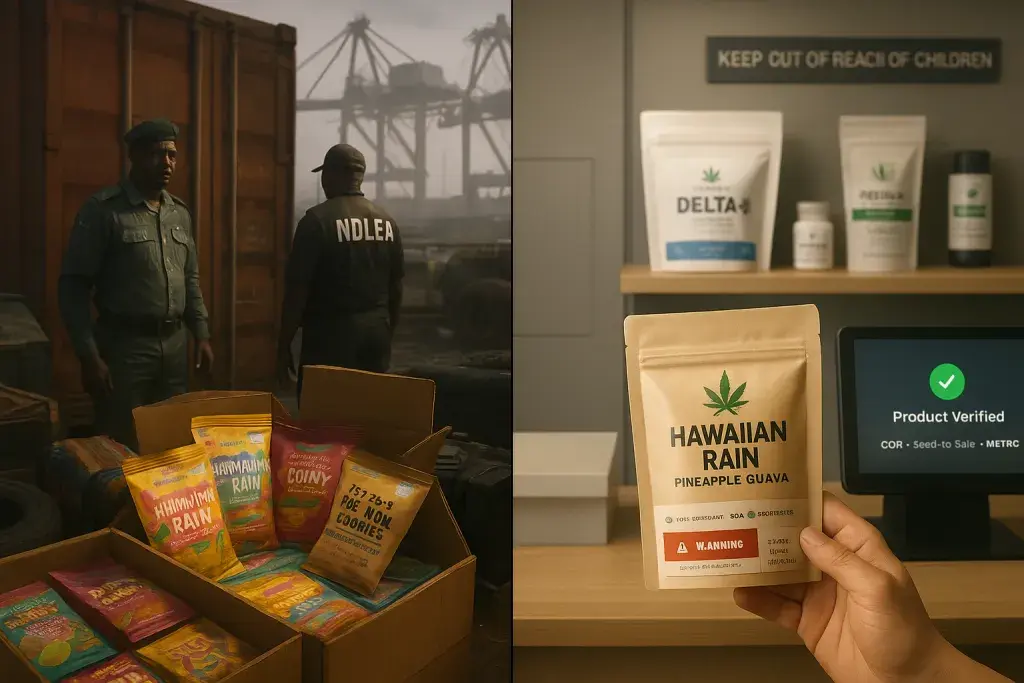
Nigeria's drug enforcement agency is now telling parents to treat gummies and cookies with suspicion, after customs officers intercepted two shipping containers at Tin Can Island Port loaded with cannabis-infused products disguised as ordinary confectionery. The consignment, tucked among used vehicles, generators and fabrics, included thousands of Delta-8 pre-roll cookies and cannabis-infused gummies bearing US-style branding, vegan claims and flavor names like Hawaiian Rain Pineapple Guava. That the products cleared as far as they did before detection says something uncomfortable about how easily compliant-looking packaging can be weaponized once it crosses a border where no regulated cannabis market exists.
Here's the operational reality that gets lost in the headlines: packaging that reads as reassuring in one jurisdiction can become a smuggling vector in another. In a licensed US market, a pouch labeled "Delta 8 Gummies, Hemp-Derived" is subject to lab testing, a certificate of analysis, child-resistant packaging rules and seed-to-sale tracking through systems like METRC. That paperwork trail, paired with point-of-sale verification at the counter, is what lets a Colorado or Michigan dispensary sell that product legally and traceably. Strip away the regulatory scaffolding - the age-gating, the batch numbers, the compliance logs a store manager pulls up on an Alaska dispensary POS platform during an audit - and what's left is just an attractive pouch that photographs well and travels easily through customs manifests.
Why compliant packaging becomes a liability abroad
US operators spend real money on compliant packaging because regulators demand it: opaque, child-resistant, clearly labeled with potency and sourcing. That's a consumer-safety win domestically. But the same design language - bright colors, snack-food branding, vegan and "all-natural" claims - is precisely what makes these products effective disguises once they leave a regulated supply chain and enter informal or illicit distribution channels overseas. Brands and packaging vendors rarely think about this downstream risk. Fair enough, it's not their jurisdiction. But it's a reminder that compliant packaging is only as protective as the regulatory system enforcing it. Alaska dispensary POS platform
What this means for operators and regulators alike
For multi-state operators and wholesale suppliers, the lesson isn't about Nigeria specifically. It's about diversion risk generally. Product that leaves a licensed facility with a clean COA and proper labeling doesn't automatically stay inside the regulated system; inventory shrinkage, unauthorized resale and cross-border leakage remain persistent enforcement concerns. Retailers should treat robust seed-to-sale tracking and tight SKU management not as bureaucratic overhead but as the actual line between a traceable supply chain and a shipment that ends up disguised as candy in a foreign port.
- Regulated markets rely on lab testing, COAs and child-resistant packaging to protect consumers domestically.
- The same branding cues can be exploited once products exit a tracked, licensed supply chain.
- Diversion and cross-border smuggling remain risks regulators and operators must actively monitor, not assume away.
- Parents and retailers alike benefit from clear labeling standards that distinguish cannabis products from ordinary snacks.
None of this suggests domestic packaging rules are the problem. It suggests the opposite: where no equivalent regulatory framework exists, the visual signals meant to build consumer trust can be turned against public safety. That gap is worth watching as illicit cannabis products continue moving through international trade routes disguised as everyday goods.