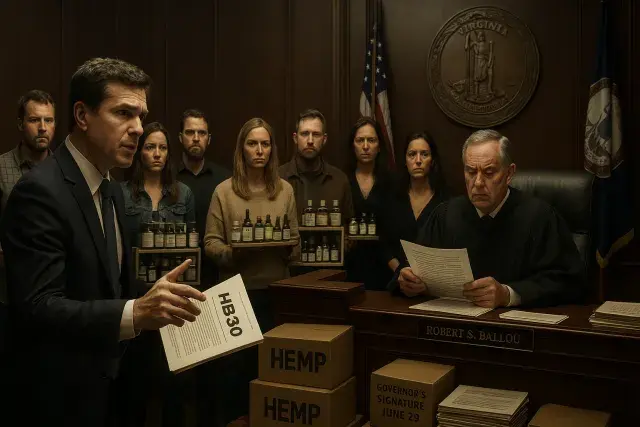
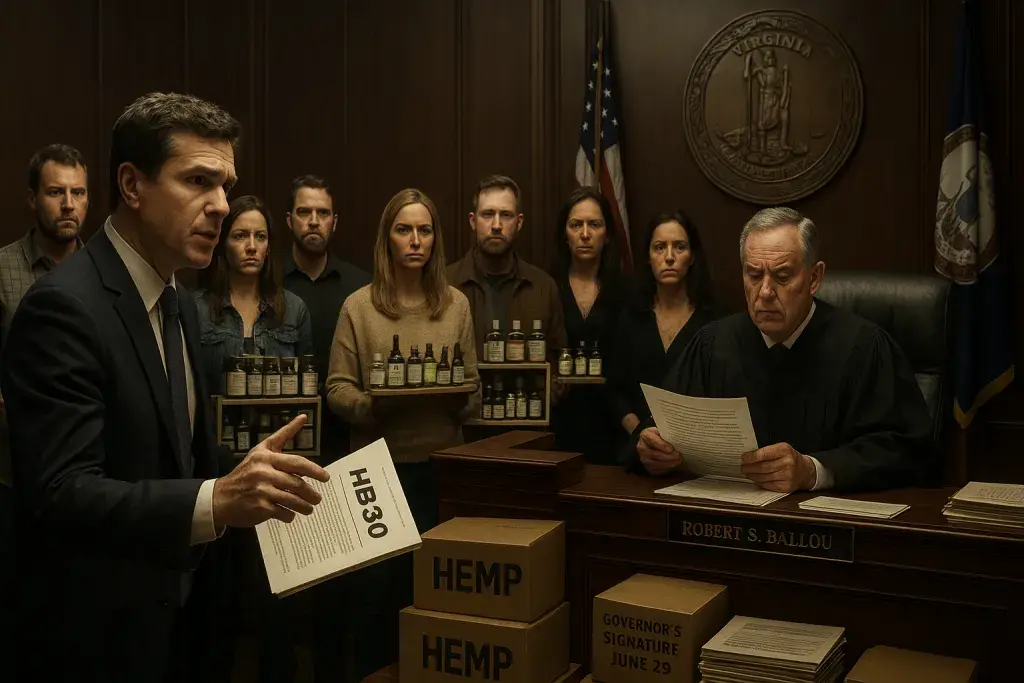
A federal judge spent nearly five hours Wednesday weighing whether to freeze Virginia's new hemp restrictions before they take effect Saturday, as store owners testified the rules could wipe out inventory, revenue, and businesses built under the state's prior framework. Seven hemp retailers sued in federal court, asking U.S. District Judge Robert S. Ballou for a temporary injunction against House Bill 30's budget-driven changes, which scrap the 25-to-1 CBD-to-THC exception and cap most hemp products at two milligrams of total THC per package. No ruling came Wednesday, though the plaintiffs' attorney, Chap Petersen, said he expects a decision by Friday - cutting it close against an Aug. 15 enforcement date.
The case lands at a moment when hemp retail across the country is being forced to reckon with regulatory whiplash that most conventional retailers never have to plan around. A dispensary or hemp shop operating in a state with clear THC limits and stable testing protocols can build inventory cycles, wholesale relationships, and point-of-sale configurations around a known rule set. Virginia operators had none of that certainty this year. Petersen argues the timeline made compliance nearly impossible: the governor didn't sign the bill until June 29, leaving businesses roughly six weeks to restructure product lines, renegotiate with manufacturers, and in some cases watch crops already in the ground become unsellable by harvest. That's a fundamentally different operational problem than what a multi-state cannabis operator faces when adjusting SKU management on a modern South Carolina dispensary POS platform - hemp retailers in states like Virginia often lack the seed-to-sale infrastructure and regulatory lead time that licensed cannabis markets have built over years.
Why the THC Threshold Matters So Much
The two-milligram total-THC-per-package limit is not a technical footnote. It redraws the line between what counts as legal hemp and what suddenly becomes an unlicensed cannabis product under Virginia law. Products manufactured and packaged in compliance with the old 25-to-1 ratio don't get grandfathered in - they simply stop qualifying. For a retailer, that means shelves full of legally acquired inventory can flip to unsellable, or worse, legally risky to possess, overnight. Cody Moorefield, owner of Simply Hemp in Collinsville, put the stakes bluntly: products legal at midnight on Aug. 14 could expose a shop owner to felony charges by the next morning. That's the kind of regulatory cliff edge that alcohol retailers or licensed cannabis operators rarely face, because those industries typically build in phase-in periods, sell-through windows, or buyback provisions when rules change.
The Supply Chain Squeeze
Unlike a vape hardware distributor that can shift inventory across state lines, hemp is agricultural. Petersen's comparison to skill-game machines - equipment that can simply be trucked to a friendlier jurisdiction - underscores why hemp businesses are structurally exposed. Crops planted in April for an October harvest were put in the ground under one regulatory regime and may come out of the ground under another. Virginia manufacturers who spent months reformulating products to fit prior compliance standards now face the same cliff as the retailers selling their goods. That ripple effect - from cultivator to processor to store shelf - is precisely why the plaintiffs are pressing for injunctive relief rather than waiting for a full constitutional trial.
What an Injunction Would and Wouldn't Do
An injunction wouldn't settle the constitutional questions Petersen has raised, including a potential takings claim tied to businesses built under the prior rules. It would simply pause enforcement while that larger case proceeds, giving retailers room to sell down existing stock and lawmakers a chance to revisit the statute. Petersen, a former state senator, said he'd rather see the General Assembly amend the law than fight it out in court indefinitely. Absent that, he said the plaintiffs are prepared to litigate the constitutional question next year - with the state potentially on the hook for damages if the restrictions are struck down.
- New rule eliminates the 25-to-1 CBD-to-THC exception statewide.
- Most hemp products now capped at two milligrams of total THC per package.
- Enforcement was set to begin Aug. 15, roughly six weeks after the governor signed the budget provision.
- Plaintiffs seek a temporary injunction, not a permanent repeal, while the broader case proceeds.
Whatever Ballou decides, the case is a preview of the friction states will keep encountering as they try to fold intoxicating hemp products into frameworks originally built for regulated marijuana markets. Retailers need predictable timelines, testing standards, and packaging rules to run compliant operations; regulators need enforceable limits to protect consumers. Virginia's dispute shows how badly those two needs can collide when the transition happens on a legislative clock rather than an operational one.